Solid Waste
PICKLES BUTTE SANITARY LANDFILL
COMMISSIONERS
Saturday afternoons (noon – 4pm) are generally the busiest time at the landfill. Wait times on Saturday afternoons often approach 45 minutes to an hour.
To avoid the long lines, we recommend visiting the landfill earlier on Saturday or sometime during the week.
*OUT-OF-COUNTY WASTE WILL NOT BE ACCEPTED WITHOUT PRIOR APPROVAL*
Perch Road through the Canyon is closed.
Our landfill team is committed to responsible waste management, environmental stewardship and serving the community.
Solid Waste Bill – Fast, Secure & Convenient!
Book a tour of the Landfill!
208-466-7288
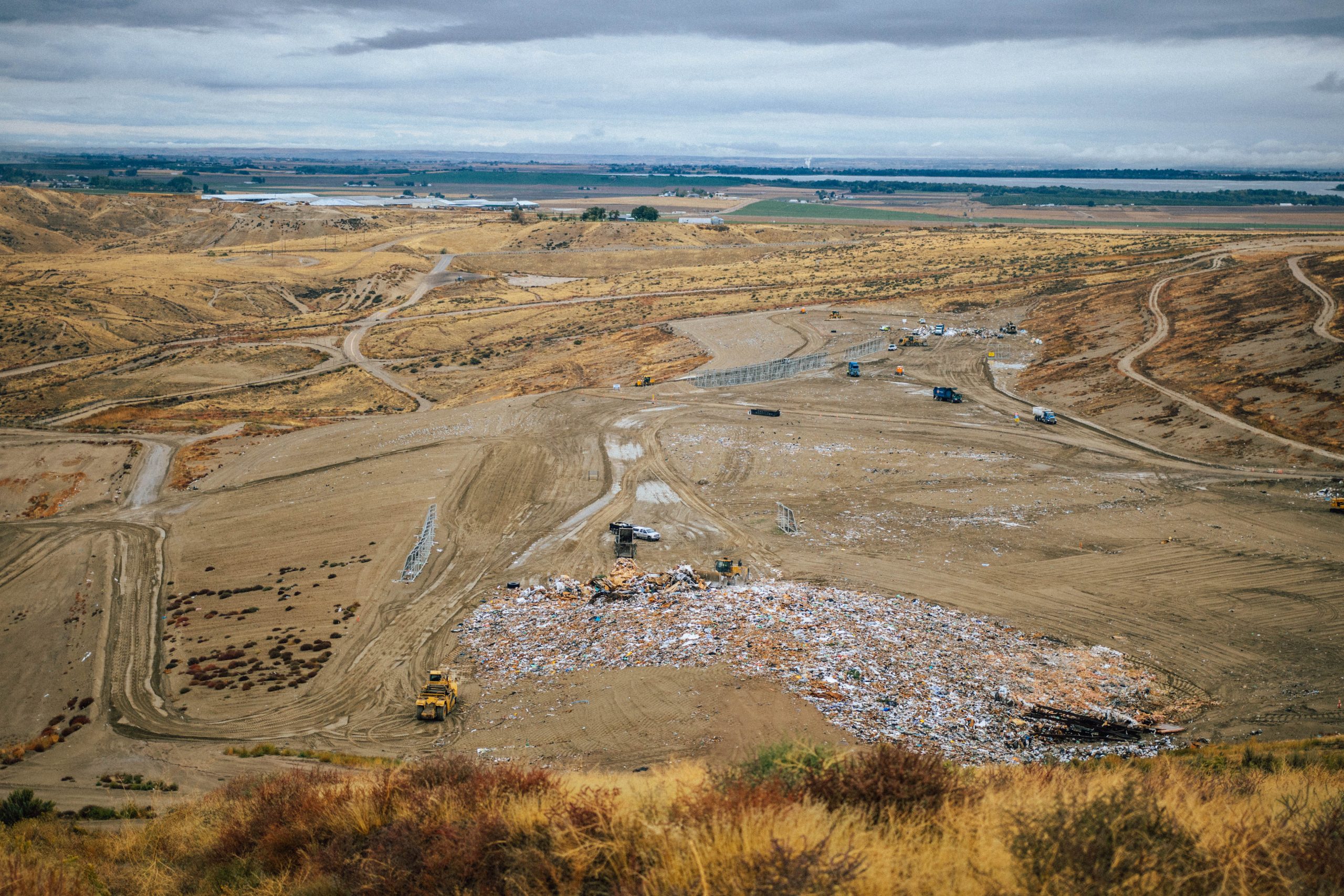
The Pickles Butte Sanitary Landfill (PBSL) is a municipal solid waste landfill (MSWLF) located at 15500 Missouri Ave. in Nampa, Idaho. The facility includes the landfill, offices, scale house, above ground storage tanks to fuel equipment, and shop for servicing site vehicles. The County owns approximately 1394 acres of land that includes the active area of the Pickles Butte Landfill that is located north of Missouri Avenue, south of Deer Flat Road, and ¼ mile west of Farner Road. Adjoining the facility in all directions is land used for agricultural purposes.
The original design for the PBSL was prepared by Blakley Engineers in 1973 and included filling three deep coulees or ravines to a top deck elevation of 2,900 feet (above mean sea level; AMSL). This elevation essentially matched the existing grade along the east side of the coulees. The capacity of the site was estimated to be 16 million cubic yards. Two of the ravines were east of Perch Road, and the third ravine was west of Perch Road. The Idaho Department of Environmental Quality (DEQ) approved the original design and operating plan in June 1973, and reconfirmed approval in May 1975 (Holladay, 1994a). The Southwest District Health Department approved the landfill in December 1979 (ibid). The plan was modified in 1980 to allow public use of off-highway vehicles (OHV) west of the active landfill area. The modified plan continued to place waste east of Perch Road, but delayed waste placement into the area west of Perch Road until necessary.
The facility began accepting municipal solid waste (MSW) in April 1983. When the Federal Subtitle D rules were implemented in the early 1990s, Canyon County (County) was required to update the design and hydrogeologic characterization for approval of the facility by the State of Idaho (Holladay Engineering, 1994a). The design and hydrogeologic characterization were approved by the DEQ on October 28, 1994, and was certified as an arid-exempt MSWLF with no potential for migration. The design included a fill boundary, which followed the top of three coulees along the east side and crossed Perch Road. The design elements included constructing 3H:1V (horizontal to vertical) exterior slopes and building the fill above grade rather than the flat top proposed in the 1973 design. This design significantly increased the overall capacity of the facility to 25.7 million cubic yards. The 1994 design also included provisions for stormwater control and a conceptual final cover design approach.
Holladay Engineering (Holladay) prepared a revised design for the facility as part of a 1997 Landfill Status Report (Holladay, 1998a). The footprint for this design is similar to the 1994 footprint except the eastern boundary was rounded rather than following the incised contour of the tops of the coulees. This design included constructing 3H:1V slopes with benches for stormwater control every 50 vertical feet. The final top deck was proposed to reach an elevation of 3054 feet. Incorporation of the stormwater benches reduced the overall capacity of the facility to 21.5 million cubic yards (16.4 million cubic meters). This plan was developed as part of facility operations and was not submitted to the DEQ.
The County obtained their original site certification for the landfill from the DEQ in August 1993 for 116.7 acre when Subtitle D was implemented. The County subsequently submitted an updated Site Certification in June 2010 (Daniel B. Stephens and Associates, 2010), which expanded the site certification boundary to 492 acres. The DEQ approved this site certification in August 2010. The County subsequently submitted an updated Site Certification to modify the site certification boundary in 2020 as part of a planned lateral expansion of the landfill. The application extended the site certification boundary to the landfill property boundary to the north and west. Approval from DEQ was received in February 2021 for approximately 600 acres. The current waste disposal area occupies the original footprint of approximately 116.7 acres, which has a natural soil liner.
Soil exceeding residential use screening levels (RUSLs) (IDAPA 58.01.24 Table 2) due to a release of petroleum products can result from a Petroleum Storage Tank (PST) system. Soil that has been contaminated with petroleum generally has a large number of contaminates with significant concentrations that could be classified as a hazardous waste under the criteria of 40 CFR 261.24. 4.6.1 Petroleum Contaminated Soil (PCS) is exempt from RCRA Hazardous Waste Requirements under 40 CFR 261.4(b)(l0). This section states:
(b) Solid wastes which are not hazardous wastes. The following solid wastes are not hazardous wastes:
(10) Petroleum-contaminated media and debris that fail the test for the Toxicity Characteristic of § 261.24 (Hazardous Waste Codes D018 through D043 only) and are subject to the corrective action regulations under part 280 of this chapter.
On a case-by-case basis, the County may accept PCS from a leaking underground storage tank (LUST) cleanup sites or other petroleum releases to the landfill for disposal, provided the PCS is below the Direct Contact Screening Level as defined in Idaho Risk Evaluation Manual for Petroleum Releases. Idaho Department of Environmental Quality. Revision No. 1. July 18, 2018. Soil above the Direct Contact screening level will not be accepted at the Site. PCS can be disposed of within the active landfill when the following criteria have been met:
- No free liquid as determined by the paint filter test (SW-846 Method 9095AB);
- Soils are non-hazardous as determined by 40 CFR 262.11, as defined in 40 CFR 261, which includes ignitability (§261.21), corrosivity (§261.22), reactivity (§261.23), and toxicity (§261.24);
- The responsible parties provide laboratory data for VOCs, MTBE, EDB, and EDC by EPA method 5035A/8260, and PAHs for diesel spills by EPA method 8270C that has been collected within the last 120 days. At least one sample is required per 1000 cubic yards of material;
- Soil Concentrations are less than the Screening level values shown in Table 2 (see below), which were generated for outdoor workers using EPA risk-modeling software. For the modeling, default climate values for Boise were selected and the worker exposure was based on working 10-hour days, 200 days per year.; and
- Soil poses no health hazard to Site workers.
The Solid Waste Director may determine that soils are not suitable for landfilling, based on strong odors or other nuisance concerns even if the concentrations in Table 2 are met. If the PCS does not meet these criteria, but are below the Direct Contact screening levels, it may be accepted for treatment at the PBSL on a case-by-case basis prior to landfilling. The soil would be placed in windrows and turned on a quarterly basis until the soil met the above the criteria. All costs associated with treatment and confirmation laboratory testing would be the responsibility of the responsible party.
This policy only pertains to petroleum contaminated soils, and under no circumstances can this policy be adapted to other hazardous substances. This procedure is subject to change without notice.
Table 1. IDEQ Screening Level Concentrations for Soil and Maximum EPA Concentrations
| Soil (mg/kg)* | Maximum Concentrations of Volatile Contaminants in Soil for Landfilling** | |||
| CHEMICAL | Vapor Intrusion | Direct Contact | Groundwater Protection | Screening Level (mg/kg) |
| Benzene | 0.08 | 8.3 | 0.025 | 3.36 |
| Toluene | 1300 | 7930 | 6.6 | 3,940 |
| Ethylbenzene | 0.25 | 39 | 7.4 | 16.8 |
| Xylenes | 27 | 6100 | 93 | 158 |
| Naphthalene | 0.12 | 44 | 21 | 10.6 |
| MTBE | 2.4 | 340 | 0.08 | 137 |
| 1,2-Dichloroethane | 0.02 | 3.7 | 0.013 | 1.32 |
| Ethylene Dibromide | 0.001 | 0.27 | 0.00014 | 0.106 |
| Acenaphthene | NA | 4470 | 200 | 5,650 |
| Anthracene | NA | 22300 | 3200 | 28,300 |
| Benzo(a)anthracene | 106 | 1.4 | 0.68 | 25.2 |
| Benzo(a)pyrene | NA | 0.14 | 2.1 | 2.64 |
| Benzo(b)fluoranthene | NA | 1.4 | 2.29 | 26.4 |
| Benzo(k)fluoranthene | NA | 14 | 22.5 | 264 |
| Chrysene | NA | 139 | 69 | 2,640 |
| Fluoranthene | NA | 2970 | 1400 | 3,770 |
| Fluorene | NA | 2970 | 240 | 3,770 |
| Pyrene | NA | 2230 | 1000 | 2,830 |
|
*Data from: Risk Evaluation Manual for Petroleum Releases, Idaho Department of Environmental Quality, August 2018 **Based on EPA Risk Modeling Software, for an Outdoor worker with a target risk of 1×10⁻⁶ and a hazard quotient of 0.1. The model is available at https://epa-prgs.ornl.gov/cgi-bin/chemicals/csl_search. -Values in bold are current screening level values. Screening level values for sub-slab and near-soil gas concentration are equivalent to EPA Regional Screening Levels (EPA, 2018) for residential and industrial ambient air divided by an attenuation factor of 0.03. -NA: not applicable because the chemical does not meet EPA volatility criteria or does not have a Regional Screening Level for ambient air. |
||||
Generators Waste Profile Form
Table 2. IDEQ Screening Level Concentrations for Soil and Maximum EPA Concentrations
| Soil (mg/kg)* | Maximum Concentrations of Volatile Contaminants in Soil for Landfilling** | |||
| CHEMICAL | Vapor Intrusion | Direct Contact | Groundwater Protection | Screening Level (mg/kg) |
| Benzene | 0.08 | 8.3 | 0.025 | 3.36 |
| Toluene | 1300 | 7930 | 6.6 | 3,940 |
| Ethylbenzene | 0.25 | 39 | 7.4 | 16.8 |
| Xylenes | 27 | 6100 | 93 | 158 |
| Naphthalene | 0.12 | 44 | 21 | 10.6 |
| MTBE | 2.4 | 340 | 0.08 | 137 |
| 1,2-Dichloroethane | 0.02 | 3.7 | 0.013 | 1.32 |
| Ethylene Dibromide | 0.001 | 0.27 | 0.00014 | 0.106 |
| Acenaphthene | NA | 4470 | 200 | 5,650 |
| Anthracene | NA | 22300 | 3200 | 28,300 |
| Benzo(a)anthracene | 106 | 1.4 | 0.68 | 25.2 |
| Benzo(a)pyrene | NA | 0.14 | 2.1 | 2.64 |
| Benzo(b)fluoranthene | NA | 1.4 | 2.29 | 26.4 |
| Benzo(k)fluoranthene | NA | 14 | 22.5 | 264 |
| Chrysene | NA | 139 | 69 | 2,640 |
| Fluoranthene | NA | 2970 | 1400 | 3,770 |
| Fluorene | NA | 2970 | 240 | 3,770 |
| Pyrene | NA | 2230 | 1000 | 2,830 |
|
*Data from: Risk Evaluation Manual for Petroleum Releases, Idaho Department of Environmental Quality, August 2018 **Based on EPA Risk Modeling Software, for an Outdoor worker with a target risk of 1×10⁻⁶ and a hazard quotient of 0.1. The model is available at https://epa-prgs.ornl.gov/cgi-bin/chemicals/csl_search. -Values in bold are current screening level values. Screening level values for sub-slab and near-soil gas concentration are equivalent to EPA Regional Screening Levels (EPA, 2018) for residential and industrial ambient air divided by an attenuation factor of 0.03. -NA: not applicable because the chemical does not meet EPA volatility criteria or does not have a Regional Screening Level for ambient air. |
||||
Industrial Wastes
Industrial waste is unwanted or residual material that is generated by manufacturing or industrial activities that are not hazardous waste but are regulated under RCRA Subtitle C. These wastes can include, but are not limited to: waste from electric power generation; fertilizer and agricultural chemicals; food and related by-products; inorganic chemicals; iron and steel manufacturing/foundries; leather and leather products; nonferrous metals manufacturing/foundries; organic chemicals; plastics and resins manufacturing; pulp and paper industry; rubber and miscellaneous plastic products; stone, glass, clay and concrete products; textile manufacturing; transportation equipment; and water treatment. This term does not include mining waste or oil and gas waste.
Industrial wastes that can be considered as normal municipal solid waste are those wastes that may be landfilled without any special procedures, handling, or testing by landfill personnel. Each industrial waste and/or waste stream that does not meet the above criteria may be evaluated individually to determine if the waste will be accepted. The burden of proof that a particular industrial waste and/or waste stream is an acceptable innocuous waste is solely the responsibility of the waste generator. Any industrial wastes that fit the above criteria will not automatically be accepted at the landfill. The Canyon County Commissioners reserve all rights to either accept or reject any industrial waste and/or waste stream regardless of data supplied by the waste generator.
The County encourages industrial waste generators to evaluate their waste stream(s) to minimize, detoxify, and recycle as much of the waste stream as possible.
Generators Waste Profile Form
Asbestos
Disposal of Asbestos Containing Materials (ACM) is regulated by criteria in 40 CFR Part 61 National Emission Standards for Hazardous Air Pollutants: Asbestos NESHAP Revision. 40 CFR 61.154 prescribes for active waste disposal sites the handling requirements of ACM from asbestos mills, demolition or renovation projects, manufacturing, spraying, and fabricating processes. The requirements on ACM from demolition or renovation projects are limited to projects involving residential facilities with greater than four dwelling units, demolition of one or more houses as part of an urban renewal project, highway construction project, shopping mall development, industrial facility, or private development (with greater than four dwelling units).
A material is considered an ACM under 40 CFR 61.154, if it contains more than one percent asbestos as determined by Polarized Light Microscopy (Appendix A, subpart F, 40 CFR part 763, section 1). This includes asbestos containing packings, gaskets, floor tile (including asphalt tile, vinyl tile, and sheet vinyl floor covering), asphalt roofing products, and any asbestos containing material that can and cannot be crumbled, pulverized, or reduced to powder by hand pressure.
The County shall comply with all disposal criteria as required by 40 CFR 61.154. The County will only accept those ACMs which are delivered to the site in conformance with handling, labeling, packaging, and all other criteria as required for waste generators and transporters of 40 CFR Part 61.
Acceptance Procedure
The following procedure details the process of identifying asbestos-containing material which are regulated by 40 CFR Part 61.
- Determine if a waste hauler is transporting asbestos-containing material.
- Determine the origin of the ACM.
- Is the material from an asbestos mill, a manufacturing, spraying, or fabricating process?
- Is the material from a demolition or renovation project?
- Does it involve a residential facility with greater than four dwelling units? or
- Does it involve the demolition of one or more houses as part of an urban renewal project, highway construction project, shopping mall development, industrial facility, or private development (with greater than four dwelling units)?
If the answer to question 1 or any part of question 2 is yes, then the material is a regulated ACM and may only be accepted using the special handling procedures described below.
Special Handling Procedure
The following procedure details the extra management criteria mandated by 40 CFR 61.154 to which the County must comply.
- ACM is not accepted after 3 pm to ensure that at least six inches of compacted non-ACM will be placed over the ACM waste during the same operating day or within twenty-four hours of disposal. If the ACM wastes are not buried within 24 hours the County will erect warning signs at all entrances and at intervals of 330 ft or less along the property line of the site or along the perimeter of the sections of the site where ACM waste is deposited.
- Waste shipment records (WSR) manifests for each ACM load must be given to the scale house attendant. A copy of an acceptable WSR form is included in Appendix C. The scale house attendant will review the WSR for accuracy, and sign for receipt of material. A copy of the waste manifest will be returned to the waste generator within 30 days of receipt of the waste.
- The County will submit, to the Southwest District Health Department, Division of Environmental Quality, and the regional Environmental Protection Agency, a discrepancy report if any incongruities are discovered with the WSR regarding waste quantities or condition of the waste. The report will be submitted within 15 days for waste volume discrepancies and 1 day for improperly enclosed or uncovered waste.
- All copies of WSR’s will be retained as part of the site record and will be available for inspection by regulatory agencies at the site during normal business hours.
- The landfill may contain buried regulated ACM anywhere within the horizontal and vertical limits of the landfill footprint.
- All applicable regulatory agencies will be notified at least 45 days prior to excavating or otherwise disturbing any ACM waste that has been previously covered. Notification shall include scheduled starting and completion dates, reason for disturbing the waste, procedures to be used to control emissions during excavation, storage, transport, and final disposal.
- A copy of all the records of ACM disposal locations and quantities will be submitted to the regulatory agencies upon closure of the landfill.
- Within 60 days of landfill closure, a property deed of the landfill will be filed which contains: statements that land was used for ACM disposal, statement that all records of ACM waste disposal locations and quantities were properly filed, and that the site is subject to 40 CFR 61 subpart M (40 CFR 61.140 through 61.157)
Generators Waste Profile Form
Cathode Ray Tubes
Cathode ray tubes (CRTs) are currently classified as characteristic hazardous wastes under RCRA. They are therefore subject to the hazardous waste regulations of RCRA Subtitle C unless they come from a household or a conditionally exempt SQG.
The County will accept CRTs from individuals as household hazardous waste for disposal at the landfill. The County will not accept CRTs from commercial enterprises, including non-profit charities, in conformance with the County’s policy for acceptance of Hazardous Wastes.
Generators Waste Profile Form
Medical Wastes
Disposal of infectious medical waste for disposal in MSWLF’s is regulated by RCRA Subtitle C, RCRA Subtitle D, Title 39 Chapter 74 Idaho Code, and IDAPA 16.03.14 – Rules and Minimum Standards for Hospitals in Idaho. When a facility identifies a waste as medical waste, it then must determine if the waste is a RCRA listed waste or a RCRA characteristic waste, either of which would classify the wastes as hazardous and subject to Subtitle C hazardous waste regulations and requirements. If the wastes are not a RCRA listed wastes or RCRA characteristic wastes, they may be classified as nonhazardous and are regulated under RCRA Subtitle D as solid wastes.
In Idaho, IDAPA 16.03.14 – Rules and Minimum Standards for Hospitals, regulate the disposal of medical wastes from hospitals. For those wastes that are not determined by the facility to be RCRA Subtitle C wastes, these rules require that prior to disposal of infectious medical waste in a properly permitted landfill, treatment of the waste must occur. The rules define treatment “shall mean any method, technique, or process used to change the character or composition of any infectious waste so as to render such waste noninfectious.”
The County will not accept any medical wastes that have been classified as RCRA Subtitle C wastes. The County may accept treated medical wastes when the treatment has rendered the wastes noninfectious on a case-by-case basis. The Medical facility must submit their treatment plan to the County for review and approval before the delivery of any treated wastes are accepted. Untreated waste will be rejected. The waste generator will be required to retrieve the untreated waste from the landfill and pay the County for any cost incurred to handle the wastes until the generator removes all infected materials from the landfill. Infected material may include additional materials that the untreated waste has come into contact.
Generators Waste Profile Form
Biosolids/Sewage Sludge
Landfills need to comply with Idaho’s Solid Waste rules under Title 39, Chapter 74, Idaho Solid Waste Facilities Act (SWFA) (State of Idaho, 1996). Idaho Code defines sludge is defined to mean “any solid, semisolid, or liquid waste generated from a municipal, commercial, or industrial waste water treatment plant, or air pollution control facility exclusive of the treated effluent from a waste water treatment plant.” Idaho Code defines septage to mean “a semisolid consisting of settled sewage solids combined with varying amounts of water and dissolved materials generated from a septic tank system.” Idaho Code Title 39 Chapter 74 in conformance with 40 CFR Parts 257 and 258 allows the deposition of both sludge and septage in municipal solid waste landfills.
The PBSL initiated a pilot test in July 2017 to evaluate the best way to handle the acceptance of Class B biosolids from the Cities of Nampa and Caldwell. As part of the acceptance procedure, the landfill requests copies of the following records from the generator (e.g., City of Nampa and/or Caldwell):
- Documentation that demonstrates that the waste meets the SWFA, which requires that the biosolids meet the paint filter test. If the biosolids passes the paint filter test, then the waste is not a liquid and can be accepted as normal solid waste.
- Records documenting the percent solids, metal concentrations (Per 40 CFR §503), and fecal coliform concentrations (Per 40 CFR §503). If it is assumed that a generator would produce 25 tons of waste twice a week, which would result in a yearly volume of 2,600 tons, and per the part 503 rules would require that sample analysis be provided every 60 days.
Based on the pilot test it was determined that the best approach for acceptance of biosolids is to incorporate the waste into the active face of the landfill without creating a depression. When a shipment of biosolids is expected, a flat area is scrapped where the biosolids can be placed on the upper floor. After the biosolids is placed, a compactor or loader is used to incorporate the biosolids into the face. This process covers the majority of the biosolids. Commercial garbage trucks are then allowed to empty their loads in the area where the biosolids were placed to further cover the material. The general public uses the lower floor and is not allowed in the area where biosolids are placed.
The acceptance criteria for biosolids is that the landfill must be notified before a shipment is received and that it must be delivered before noon. Biosolids will be incorporated into the landfill and covered with as many loads of waste as possible. If moisture content or odors becomes a problem, the landfill director will discuss the problem with the generator to allow them to amend their treatment process to reduce the concern. The PBSL reserves the right to refuse acceptance of biosolids.
In general, commercial industrial, and sewage sludge will not be accepted at the landfill. The Canyon County Commission will consider acceptance of sludge from commercial, industrial, and sewage waste generators on a case-by-case basis. The burden of proof that a particular sludge stream is an acceptable innocuous waste would solely be the responsibility of the waste generator. The Canyon County Commission reserves all rights to either accept or reject any commercial, industrial, or sewage sludge waste stream regardless of data supplied by the waste generator.
We recycle tires, waste oil, fuel and antifreeze, batteries, refrigeration units, metal (stoves, ranges, washing machines, clothes dryers, water heaters, furnaces, dishwashers, microwaves and other types of metal), e-waste, clean wood, drywall, concrete, paint. By keeping these items out of the landfill, we extend its lifespan and reduce the environmental impact. Please separate these items from your load to ensure they can be properly recycled.
- Tires (need picture of tire pile and tire shreds)
Pickles Butte Landfill will accept up to fifteen (15) passenger car, light pickup, motorcycle, and SUV vehicle tires. Tires larger than passenger/light truck will not be accepted.
Waste tires will not be accepted from commercial enterprises.
Tires can be recycled with rims. Tires are $3.50 each plus load weight.
Tires brought to the landfill are recycled into fuel and playground/sports field turf.
- Waste Oil, Fuel and, Antifreeze (need picture of area at transfer station)
Pickles Butte Landfill will accept up to five (5) gallons of used oil, ten (10) gallons of used gasoline or diesel fuels, and five (5) gallons of antifreeze. Waste oil from commercial enterprises such as gas stations, oil change shops, or private fleet maintenance shops, etc. will not be accepted for disposal at the landfill.
There is no extra charge for disposal of waste oil, fuel, and antifreeze
- Batteries (need picture of area at transfer station)
The disposal of lead acid batteries in landfills is prohibited. Lithium-Ion batteries??
Alkaline Batteries (AA, AAA, D, etc.) can be disposed of at the landfill.
There is no extra charge for disposal of batteries.
- Refrigeration Units (need picture of area at transfer station)
Pickles Butte Landfill accepts EMPTY refrigeration units.
There is a $20.00 charge for refrigeration units plus the weight of the load.
- Metal (need picture of metal pile)
Pickles Butte will accept stoves, ranges, washing machines, clothes dryers, water heaters, water treatment systems, furnaces, dishwashers, or microwaves. Metal is collected for recycling and is placed in the metal pile on the top deck.
There is no extra charge for disposal of metal.
- E-Waste (need picture of e-waste)
Electronic waste, such as computer towers, monitors, printers, laptops, cell phones, cable boxes, DVD players, satellite boxes, and rechargeable batteries are accepted for recycling.
There is no extra charge for disposal of e-waste.
- Clean Wood (picture of clean wood pile)
The County desires to facilitate the recycling of as much of the waste stream as is practical. There are no regulations that prohibit the acceptance of clean wood waste, that is wood from construction and demolition that is untreated. This includes dimensional lumber, cutoffs, pallets, OSB, and plywood. The County does not accept railroads ties, painted wood or pressure treated wood for grinding and must be disposed of in the landfill. The County does not accept railroads ties, painted wood or pressure treated wood for grinding and must be disposed of in the landfill. Green waste, such as woody yard debris, is also diverted from the landfill.
Wood waste is directed to an area on the top where it is separated into two piles, one for clean wood waste and one for green waste.
There is no extra charge for disposal of clean wood.
- Drywall
Drywall scraps from new construction that is separated from other construction waste can be diverted to the clean wood pile, where it is ground at a ratio of 3:1 to make animal bedding. When the amount of drywall exceeds this ratio, it is handled as waste and placed into the active face of the landfill.
There is no extra charge for disposal of drywall.
- Concrete (picture of concrete pile)
Clean concrete, pavement and brick waste brought to the landfill is being diverted to a separate area where it is rubberized by a private contractor into small pieces (typically 2- to 6-inch). The crushed concrete can then be used as raw material to make new concrete or as backfill. The material is either used as gravel for landfill roads or hauled offsite by a third-party contractor.
There is no extra charge for disposal of concrete.
- Paint
- Glass
Glass is not currently accepted for recycling at Pickles Butte Landfill. However, several facilities in the Boise area do offer glass recycling services:
Albertsons (16th & State St) – 1650 W. State St., Boise, ID 83702
Albertsons (Parkcenter Blvd) – 1055 E Parkcenter Blvd, Boise, ID 83706
Albertsons (Vista Ave) – 1653 S Vista Ave, Boise, ID 83705
Boise State University – 1350 S. Earle St., Boise, ID 83706
Cole and Ustick Library – 7557 W. Ustick Rd., Boise, ID 83704
Country Club Plaza – 4500 W. Overland Rd., Boise, ID 83705
East Boise (Old Penitentiary) – 2420 E. Old Penitentiary, Boise, ID 83712
Environmental Abrasives – 4301 S Federal Way, Boise, ID 83716
Pacific Steel and Recycling – 5120 Emerald St, Boise, ID 83706
Western Recycling – 1990 S Cole Rd, Boise, ID 83709
Common Types of Waste
- MSW $18.50/ton
- Construction/Demo $38/ton
- Green Waste $14.50/ton
- Clean Wood $20/ton
- Clean Sheet Rock $20/ton
- Tires $3.50 each (15 tires max)
- Refrigerators/AC $20 each
Hard to Handle Waste
Large Bulk items (Furniture, Boat Hulls, Old Mobile Homes)
There are no regulations that prohibit the acceptance of old furniture, boat hulls, or old mobile homes at the landfill, but due to their size, additional handling fees may apply.
The County encourages residents to donate or sell used furniture, boat hulls, or old mobile homes for reuse or recycling when possible. Advance notification for disposal of large items is requested so an area can be prepared.
Drivable vehicles to include motor homes and buses will NOT be accepted. Motor Home Memo
Dead Animals
The County will accept dead animals from the general public, additional handling fees may apply. The County will not take dead animals from commercial operations, such as dairies, confined feeding operations, or laboratory operations. With approval from the landfill director, small quantities of dead animals may be taken from animal shelters or veterinary practices. All dead animals are individually buried in the working face at the time of delivery. The landfill reserves the right to refuse acceptance of dead animals.
There is a credit card processing fee of 2.39%, $1.00 minimum. Prices subject to change based on County Fee Schedule.
Cover Your Load
Requirements for covered waste loads will be enforced for all loads delivered to the Pickles Butte Sanitary Landfill. The applicable County Code section from Chapter 2 Article 3 is provided below:
02-03-03(3) Prohibited: It shall be unlawful for any person hauling garbage, refuse, rubbish or trash of any kind upon the public highways of Canyon County outside the corporate limits of any municipality within Canyon County to haul garbage, refuse, rubbish or trash without covering and securing such garbage, refuse, rubbish or trash in a manner as to prevent scattering or blowing or loss of the material being so transported. (Ord. 05-011, 4-6-05, eff. 4-10-05: 2005 Code)
02-03-15-(2)Penalty: Any person violating any section of this article, other than sections 02-03-08 or section 02-03-13(4) of this article, shall be guilty of a misdemeanor and each separate violation hereof shall be punishable by fine or not more than three hundred dollars ($300.00). (Ord. 05-012, 4-12-05, eff. 4-17-05: 2005 Code)
Landfill Safety
- No Smoking
- No Alcohol Consumption
- Wear proper footwear
- Secure your load before arrival
- Follow all posted signs & traffic flow
- Keep a safe distance from heavy equipment
- When unloading, watch for nails, metal or other sharp debris
- Children and pets must stay inside the vehicle at all times




Monday – Saturday
8:00 am – 5:30 pm
Gates close at 5:30 pm
Closed on Sunday
OPEN Holidays
Idaho Human Rights Day
Presidents’ Day
Columbus Day
Veterans Day
Juneteenth
CLOSED Holidays
New Year’s Day*
Memorial Day
Independence Day
Labor Day
Thanksgiving Day
Christmas Day**
*Open on Jan. 2
**Open on Dec. 26
Please plan your waste deliveries accordingly. Regular hours resume the following business day.
FREE HOUSEHOLD HAZARDOUS & ELECTRONIC WASTE DISPOSAL EVENTS
- December 9, 2026 – O’Connor Field House
- March 13, 2027 – Location TBD
- June 9, 2027 – O’Connor Field house
- September 11, 2027 – Location TBD
10:00 a.m. to 4:00 p.m.
DISPOSAL EVENTS ARE FREE FOR HOUSEHOLDS ONLY! BUSINESS WASTE WILL NOT BE ACCEPTED WITHOUT AN APPOINTMENT. *CALL (208) 577-4737 TO SCHEDULE APPOINTMENT
PLEASE LIMIT WASTE TO 25 GALLONS AND/OR 20 ITEMS PER HOUSEHOLD.
Common Household Hazardous Waste Products Include: household cleaners, pesticides, poisons, motor oil, paints, solvents, lightbulbs, batteries, herbicides, pesticides, automotive products and batteries, propane tanks.
E-Waste (Anything Electronic)
- CELL PHONES
- COMPUTERS
- MONITORS
- PRINTERS
- AUDIO / VIDEO
- SMALL DEVICES
- OTHER EQUIPMENT
NO Biological or Radiological Waste Will Be Accepted. NO Explosives. NO Ammo. NO Rx Drugs.
Free Day 2027 TBD
- FREE RESIDENTIAL CLEAN-UP WASTE ONLY: Up to one ton of residential clean-up waste will be accepted without charge. Residential clean-up waste in excess of one ton will be accepted in accordance with the regular landfill fee schedule with a credit given for the first ton.
- REFRIGERATORS: Only one refrigeration unit will be accepted free of charge per household. Additional refrigeration units will be accepted in accordance with the regular landfill fee schedule.
- TIRES: Up to four (4) passenger car/light truck tires will be accepted free per household. Additional tires will be charged in accordance with the regular landfill fee schedule. Tires larger than passenger/light truck will not be accepted.
- WOOD WASTE AND METAL:Up to one ton of wood waste and metal will be accepted without charge. Wood waste and metal in excess of one ton will be accepted in accordance with the regular landfill fee schedule. Please note that wood waste and metal should be separated from other waste, as should tires and refrigeration units.